Photographing a destination wedding in Japan on film
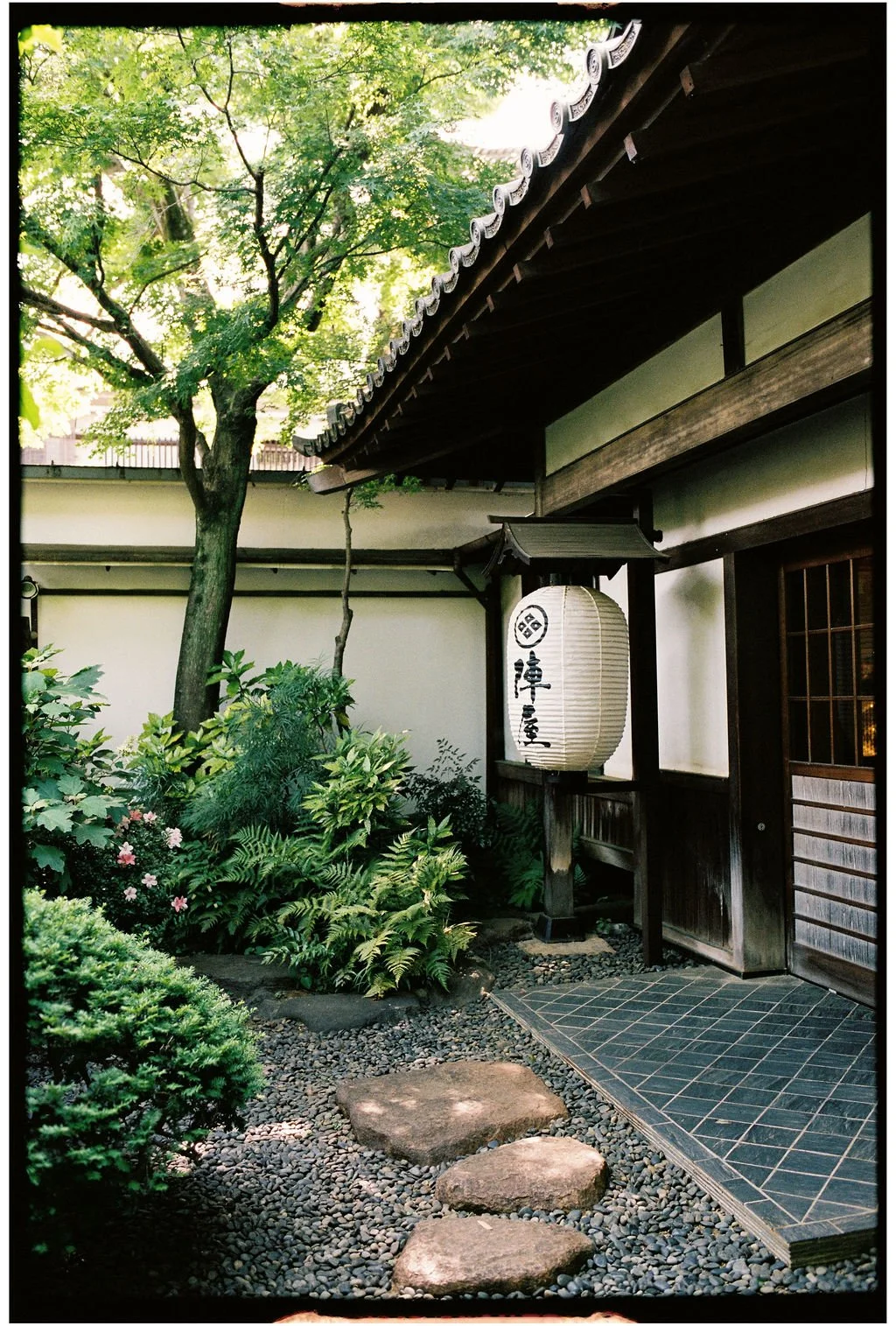
The front entrance of Tsurumaki Onsen Jinya ryokan.
From Travel Photography to a Destination Wedding in Japan
As someone who was a travel photographer and enthusiast long before becoming a wedding photographer, the prospect of being flown to a distant continent to capture an event was beyond exciting.
Although I regularly travel within the UK and fly around Europe to photograph weddings throughout the summer, until this wedding I had never travelled more than three or four hours from home for a wedding.
That changed when a couple based in Europe sent me an enquiry for a wedding in Japan. Japan? I could hardly believe my eyes when I read the email. I replied hopefully, but I wasn't too confident I'd get the booking. A wedding that far from home is unusual even for photographers who regularly work internationally.
On my first call with the couple, I learned that they simply loved Japan and couldn't imagine getting married anywhere else. They also loved analogue photography, and having a film wedding photographer was essential to them. We had the loveliest conversation and, before long, they booked me.
Combining a Wedding in Japan with a Personal Trip
Japan had been on my bucket list for years: it’s one of those places I'd wanted to experience at least once. I also didn't want to make a 13-hour flight from the UK to Tokyo purely for the wedding and immediately fly home again. My partner Matt was keen to come too, so we decided to turn the trip into a longer adventure.
Our itinerary started in Tokyo, after a direct flight from London Heathrow, before taking us to Kyoto, Osaka and Nara. We then returned to Tokyo for the wedding. Afterward, we added a few days on Ishigaki in Okinawa Prefecture, where we finished the trip with some scuba diving. I'll share more about the personal itinerary in a separate post.
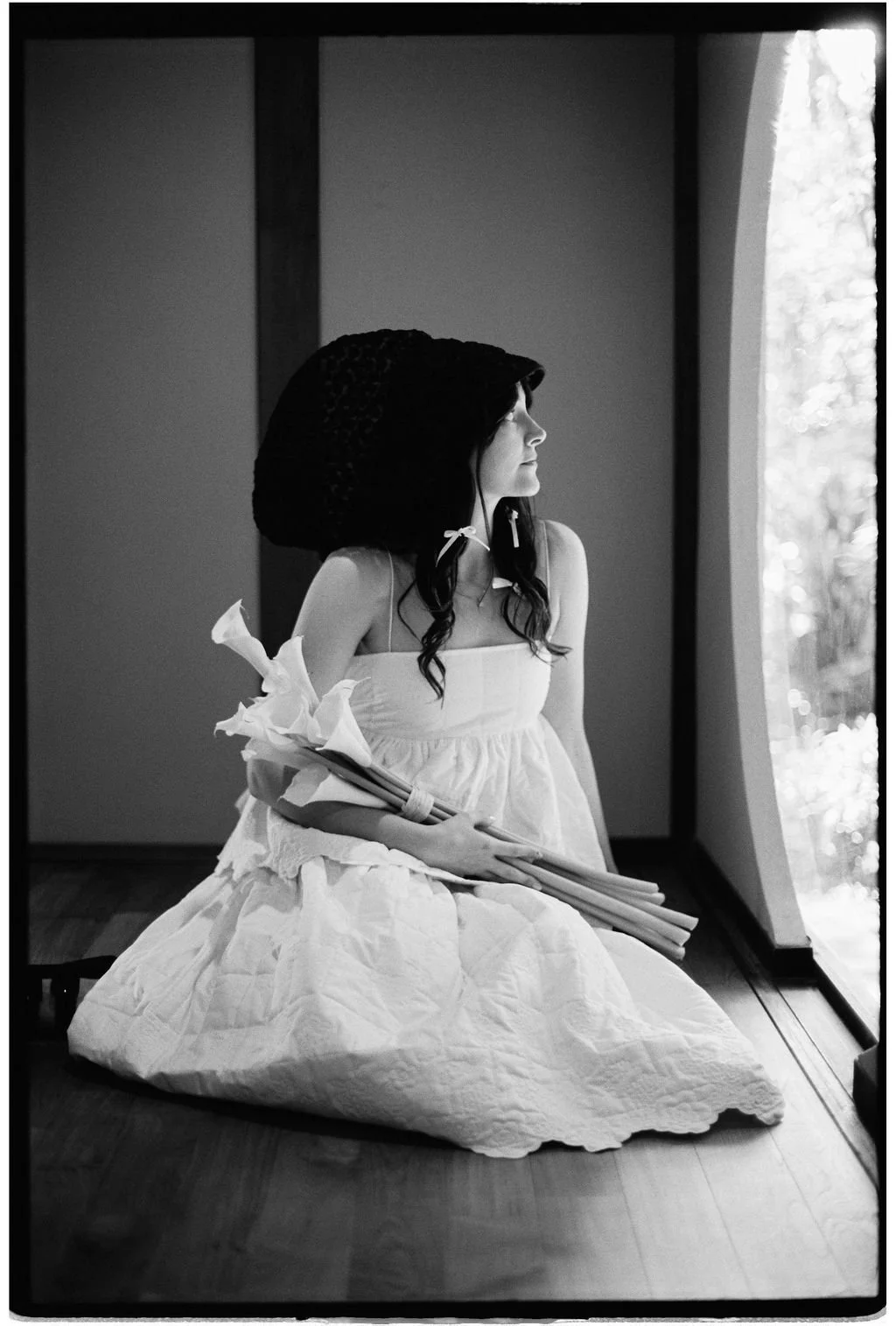
The bride sitting in front of one of the ryokan’s round windows.
A Traditional Japanese Wedding Venue: Tsurumaki Onsen Jinya
The couple chose to marry about an hour from Tokyo, in Kanagawa Prefecture, at Tsurumaki Onsen Motoyu Jinya, a historic traditional Japanese inn, or ryokan.
A ryokan is a traditional Japanese-style inn, typically characterised by tatami-mat floors, sliding shoji screens and Japanese-style sleeping arrangements. Guests may wear cotton yukata robes, enjoy hot spring baths (onsen) and dine on seasonal multi-course cuisine.
Tsurumaki Onsen Motoyu Jinya sits within a 33,000-square-metre garden and has a long history as a traditional hot spring inn. The property has 16 guest rooms, each with its own character, and its gardens and architecture make it an extraordinary setting for photography. The inn is also just a short walk from Tsurumaki-Onsen Station, making it surprisingly accessible from Tokyo.
Why Location Scouting Matters When Photographing on Film
I was incredibly excited to photograph at Jinya, but I also knew I needed to understand the spaces and lighting before attempting to photograph an entire wedding on 35mm and 120 film.
Because the couple were holding a rehearsal the day before, I arranged to visit the venue in advance. If you're photographing a destination wedding somewhere you've never been before, particularly when travelling so far that a last-minute return visit isn't realistic, I highly recommend arranging a location scout whenever possible.
It turned out to be extremely helpful. I immediately noticed both the strengths and the challenges of the venue, which meant I could make decisions about film stocks, exposure and positioning before the wedding day.
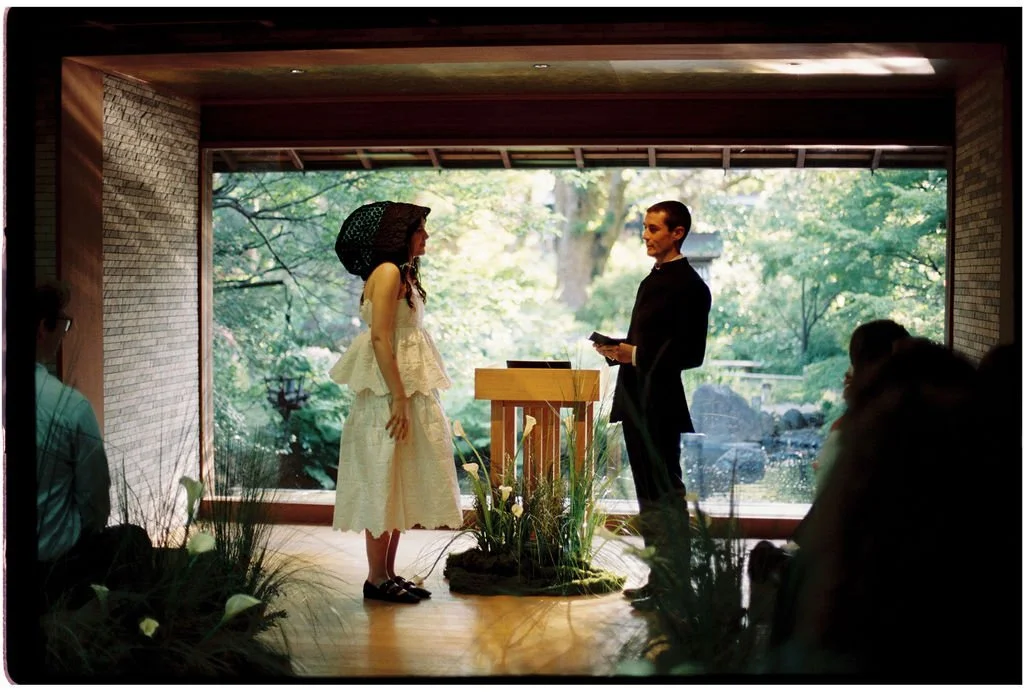
A scene from the ceremony that showcases the huge glass window with the pond and garden in the background.
Working with Light in the Gardens and Ceremony Space
The Zen gardens were by far the easiest and most rewarding spaces to photograph. They were bright, beautifully composed and full of plants, ponds and traditional Japanese architecture. Everywhere I looked there was another frame.
The indoor spaces required more thought. The ceremony room is a beautiful space overlooking a pond, with a large glass window behind the couple. It creates a stunning backdrop and brings in beautiful natural light, but it also means the couple can become strongly backlit.
A silhouette can be a lovely creative image, but I didn't want the entire ceremony photographed that way. In a situation like this, you have a few options: you can add fill flash to balance the exposure, or you can expose further into the shadows if preserving the ambient atmosphere is the priority. The important thing is to make that decision before the ceremony begins rather than discovering the problem halfway through.
The reception room was a large hall with windows overlooking the gardens. The available light was beautiful but relatively dim and warm, so I chose Kodak Portra 800 for this part of the day. Having a faster film stock available gave me more flexibility while retaining the natural, atmospheric quality I wanted.
What Was It Like Photographing a Wedding in Japan?
In some ways, photographing a wedding in Japan was very different from working in the UK or Europe. In other ways, a wedding is still a wedding: people are excited, emotional, nervous, affectionate and completely absorbed in celebrating with the people they love.
My commute was certainly unique. I took the Odakyu Line from Shinjuku to Tsurumaki-Onsen Station and even spotted Mount Fuji on the journey, something you definitely don't get on my usual commute.
Many of the rooms at the venue were tatami-style, which meant taking my shoes off repeatedly throughout the day. It wasn't exactly ideal when carrying cameras and moving around constantly, but I quickly got used to it.
The room reserved for vendors was spacious, with sliding doors and beautiful views of the gardens through large round windows. I absolutely loved it. The couple also explained that vendor meals can work differently in Japan, with vendors sometimes expected to bring their own food. They wanted to make sure everyone was looked after, though, and I was treated to a delicious bento box with miso soup, rice and pork.
I also really enjoyed working with the wedding planner, Ayaka Ishimura, and her assistant. Ayaka was incredibly organised and spoke impeccable English, which made communication throughout the day very easy. The couple had made some wonderfully unconventional choices, but the planning team handled everything smoothly.
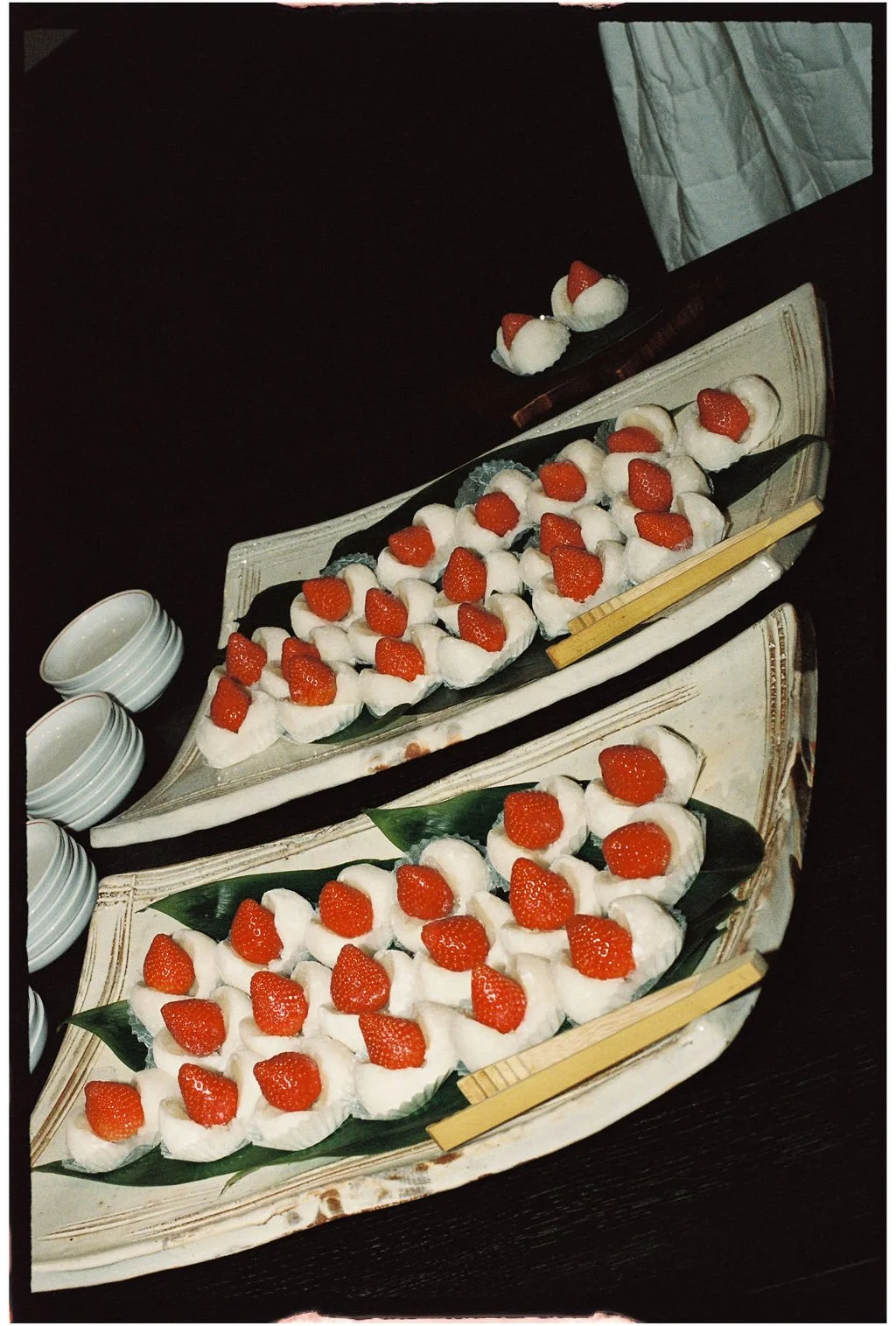
The trays filled with strawberry daifuku, a traditional Japanese dessert.
Japanese Wedding Traditions
There were also a couple of moments that felt particularly special to photograph because they were rooted in Japanese tradition.
One was Kagami Biraki, a traditional sake-barrel opening ceremony. The couple use wooden mallets to break open the lid of a wooden sake cask, symbolising a new beginning, harmony and shared good fortune. It was a brilliant moment photographically because it naturally brought everyone together around the couple.
Instead of a traditional wedding cake, the couple chose strawberry daifuku (ichigo daifuku), a Japanese sweet made with mochi, sweet red bean paste and a fresh strawberry. It was a wonderfully personal alternative and another lovely example of how they incorporated Japanese culture into their celebration.
Travelling with Wedding Film
One of the practical questions I was most conscious of before travelling to Japan was how to safely transport more than 40 rolls of film through multiple airports.
Japan has a particularly strong relationship with analogue photography, both through its historic camera industry and its continuing enthusiasm for film photography. I carried all of my exposed and unexposed rolls in my Domke bag and requested hand inspections at every airport I travelled through: London Heathrow, Tokyo Haneda and Ishigaki.
I didn't have any problems. In Japan, the security staff were particularly meticulous: they inspected the rolls individually and carefully returned them to my bag.
That was my experience on this particular trip, rather than a guarantee that every airport will handle film in exactly the same way, so I would always recommend checking current airport guidance before travelling and allowing plenty of extra time at security. I also strongly recommend keeping your film easily accessible and asking for a hand inspection rather than assuming it can safely go through an airport scanner (avoid modern CT scanners especially).
Japan is also one of the world's great destinations for anyone interested in vintage cameras and analogue photography. I discovered some fantastic camera shops during the trip, but I'll save those for a separate post about my Japan itinerary.
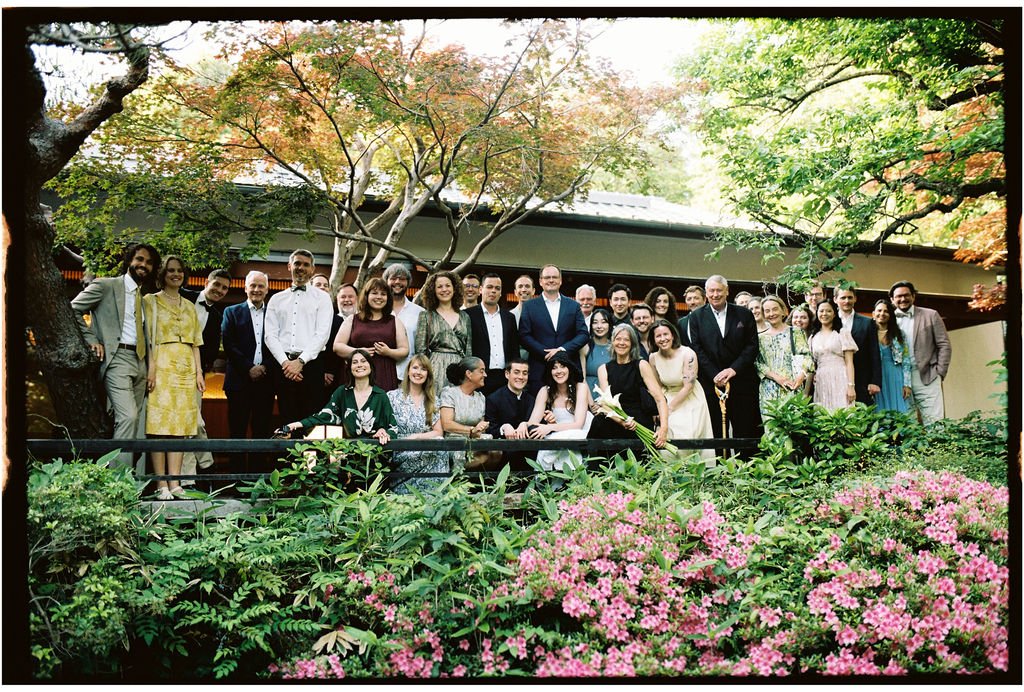
A group photo taken outside in the ryokan’s gardens.
The Experience of Photographing a Wedding in Japan on Film
Looking back, this wedding still feels slightly surreal. Sometimes I have to pinch myself that it actually happened, and it was undoubtedly one of the highlights of my career as a film wedding photographer.
I'm incredibly grateful to the couple for trusting me to travel such a long way and document one of the most important days of their lives on film. They were also genuinely lovely people to work with. After the wedding, they invited me to join them at a nearby jazz bar to continue the celebrations. I would have loved to stay longer, but I had a train to catch and an airport journey the following morning.
The time I spent with them felt like being with old friends, which is one of the things I love most about documentary wedding photography: you arrive as a stranger, spend a day immersed in someone's story, and leave feeling as though you've been given a small window into their world.
Thank you, A & K, for this wonderful adventure in the Land of the Rising Sun.
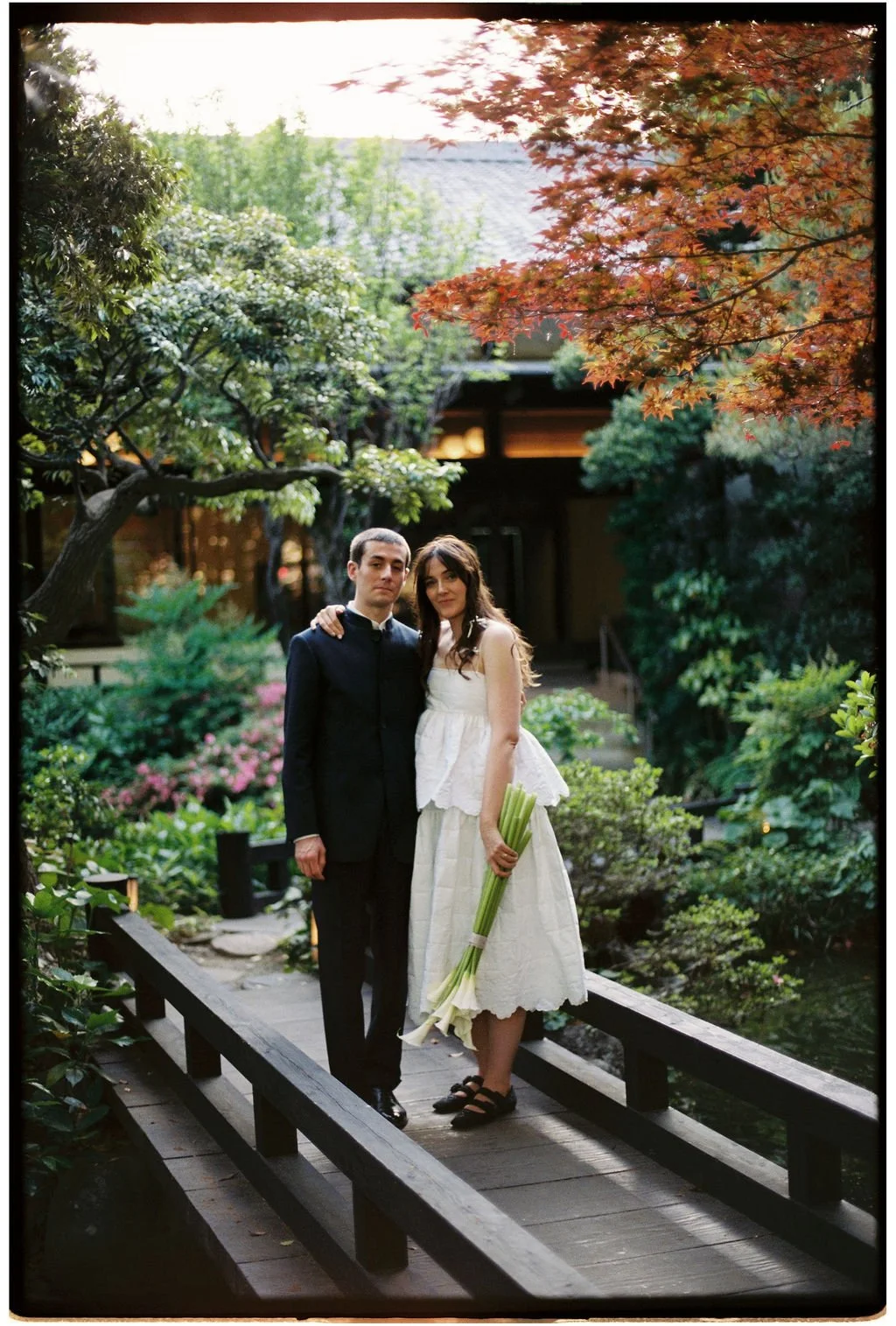
A portrait of the couple standing on one of the bridges above the ryokan’s ponds.